Showing posts with label Telugu Wedding Ceremony. Show all posts

TELUGU PRE-WEDDING RITUALS


The rich and varied cultural heritage of Andhra Pradesh, a southern state of India, is reflected in the ceremonies conducted there. Almost every festivals are celebrated with religious observance, holding supreme importance in the lives of the residents of the state. One such important occasion in one's life is wedding, which is usually organized in the typical Telugu way in the region. 

A number of rituals and ceremonies are observed by the people, native to the place. Although minor differences do exist in the communities, in the way the marriage is organized, certain rituals remain common for them. In the following lines, we have given detailed information on the Telugu pre-wedding rituals.

Telugu Pre-Wedding Customs

Muhurtham
An auspicious time for the marriage, also known as muhurtham, is chosen by the family astrologer. The Telugu people generally avoid months including Aashad, Bhadrapad and Shunya, because they are considered inauspicious time for the ceremonious occasion.

Pendlikoothuru 
In the Pendlikoothuru ceremony, turmeric paste and oil is smeared to the bride and the groom, at their respective homes. This is done to cleanse their skin, so that a natural glow is radiated. After bathing the bride and the groom, they are given a new set of clothing to wear. The bride is adorned with flowers and jewelry.

Snathakam 
Snathakam ritual takes place at the bridegroom's residence before the muhurtham. As a part of this custom, the groom is asked to wear a silver thread on his body. The ritual is conducted a few hours prior to the wedding.

Kashi Yatra
After reciting the Vedic verses, the groom pretends to go on a Kashi yatra. He shows that he has discarded the worldly pleasure an is no more interested in leading a family life. He is then stopped by the brother of the bride, who persuades him to assume the responsibility of a householder.

TELUGU POST-WEDDING RITUALS


The post-wedding rituals observed by the Telugu speaking people in India are very charming to look at. After the wedding ceremony is over, the bride enters the groom's house formally. She is given a hearty welcome by the groom's family members. 
The uniting of mangalsutra takes place after a fortnight. 

Although the post-marriage rituals of a Telugu wedding are limited to two, they symbolize a lot of meaning and are something that should not be missed out. In fact, they mark the peaceful culmination of the wedding and the delightful commencement of a new family life. Here in this article, we have discussed about the Telugu post-wedding rituals.

Telugu Post-Wedding Customs

Grihapravesh
After the culmination of the wedding ceremony, the bride is formally taken to the groom's house. This is called grihapravesh of the bride. As she steps into her new home, she is welcomed by the groom's family members, including his mother and close relatives.

Uniting The Mangalsutra
Grihapravesh is followed by a ceremony, wherein the mangalsutra is united. As a customary, the Telugu speaking people unite the two mangalsutras (which was tied by the groom around the bride's neck), on a common thread. This ritual is done sixteen days post wedding. 

This ritual can be performed by either the groom or an elderly member of the family. A few black or golden beads are slipped between the two 'plates' of the mangalsutra, so that they do not clash with each other. The unison of mangalsutra signifies the harmony between the two families. After the ceremony is over, the bride takes a bath and wears a new sari.

TELUGU WEDDING RITUALS


The rituals conducted by the Telugu speaking people during the ceremonious occasion of wedding are different from those conducted in neighboring southern states of India. In Andhra Pradesh, the Telugu people follow their own traditions, while conducting a wedding. 

The bride's maternal uncle and her brother play a prominent role at the time of the her marriage. Apart from being an event that calls for religious observance, the traditional Telugu wedding consists of some fun moments as well. If you want to know more about the Telugu wedding rituals, then this article is what you need. Here, we have provided comprehensive information on the ceremonies conducted during traditional Telugu marriage.

Telugu Wedding Customs

Mangala Snaanam 
As a part of Mangala Snaanam custom, the bride and groom are required to take an auspicious bath on the wedding day. The aim is to purify them and make them prepared to perform sacred rites.

Aarti
Oil is applied to the bride and groom at their respective houses. Thereafter, the family members get together to perform Aarti. They pray to Lord to give wisdom to the bride and groom to lead their life happily.

Ganesh And Gowri Puja
Before the wedding ceremony, the groom attends the Ganesh pooja, which is conducted at the mandapam.

Kanyadaan
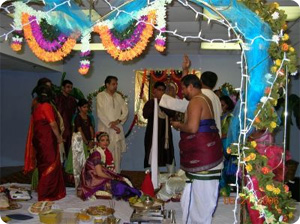
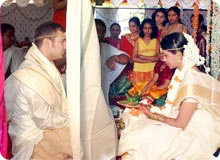
Kanyadaan is the ceremony in which the girl's family hands over their daughter's responsibility to the groom. During the ceremony, the bride sits in a bamboo basket. Her maternal uncle brings her to the mandapam. Until the completion of the kanyadaan, the bride and the groom are not allowed to look at each other and therefore, they are separated by a curtain that is place between them, as a partition. Thereafter, the bride's parents wash the groom's feet, assuming him as an 'avatar' of God.

Jeelakarra Bellamu & Madhuparkam
The priest recites the shlokas from the Vedas. Thereafter, the couple is asked to smear a paste made from cumin seeds and jaggery on each other's hands. This custom is referred to as Jeelakarra-Bellamu. This ceremony is observed to communicate that the relationship of the married couple is unbreakable and inseparable.

As a part of Madhuparkam ritual, the bride dresses up in white cotton sari with red border. On the other hand, the groom wears white dhoti with red border. White is the color for purity and red is for strength.

Sumangli
Ten married women (sumangalis) accompany the bride. Six out of the ten women hold plates containing a mixture of rice and turmeric powder, while the rest of the four hold small lit lamps in their respective plates. Rice represents abundance, while the lit lamps symbolize light.

Tying of the Mangalsutra
In order to perform the ritual, the partition between the bride and the groom are removed. After removing the partition, the groom ties the two strings of the mangalsutra, each with a golden disc, around the groom's neck. The mangalsutra represents the physical, mental and spiritual union of the couple. In the Telugu wedding, the groom ties three knots of mangalsutra.

Kanya Daan Akshata 
In the Kanya Daan Akshata ceremony, the bride and groom exchange garlands. People witnessing this occasion come forward to bless the couple, by sprinkling flower petals and rice coated with turmeric powder.

Saptapadi
As a part of the Saptapadi ritual, the groom and bride walk seven steps together around the fire, while chanting mantras. When the pheras are conducted, the pallu of bride's sari is tied to one end of the groom's dhoti.

Sthaalipaakam 
Sthaalipaakam is a ritual wherein the groom adorns the feet of the bride with silver toe rings. In order to ward-off the evil eye, she is asked to wear a string of black beads during the ceremony.

Archive