Showing posts with label MUSLIM WEDDING CEREMONY. Show all posts

MUSLIM POST-WEDDING RITUALS


In India, wedding is something that cannot be restricted to a single-day celebration. People in different communities, following different religions, have their own way of honoring the newly wed couple, post marriage


The post-wedding rituals followed by Muslims are divided into four phases, wherein the bride is bid goodbye by her family and is welcomed to her 'new home', by the groom's family. All the four phases of the rituals are filled with touching moments. If you want to know more about post-wedding rituals followed by Muslims, then go through the following lines.

Muslim Post-Wedding Customs

Rukshat Ceremony 
With tearful eyes, the bride�s family and friends bid her goodbye, before she leaves for her house with her husband. The bride�s father places his daughter�s hand in the hand of his son-in-law and requests him to take good care of his dear daughter.

Welcoming The Bride 
Giving a warm welcome to her daughter-in-law, the groom�s mother raises the Quran above her head, as she enters her new home.

Chauthi Custom 
Chauthi custom takes place on the fourth day after marriage, in which the bride visits her parental house.

Valimah Ceremony 
Valimah ceremony is the lavish reception party that the groom�s family hosts for welcoming the bride. It is an occasion that aims to facilitate intimate relationships between the two families

MUSLIM WEDDING RITUALS


Wedding is an important turning point in everyone's life. The ceremonious occasion is organized and celebrated in myriad ways all around the world. Different communities of the society have their own way of organizing the most important occasion. The wedding rituals are broadly divided according to the religions. The Muslims all over the world have a unique way of tying the wedding knot. Most of the Muslim weddings in India, whether simple or extravagant, are arranged by following the age-old rituals. In the following lines, we have provided information on Muslim wedding rituals.

Muslim Marriage Customs

Welcoming The Baraat 

To announce the arrival of groom�s baraat at the doorsteps of the bridal residence or wedding venue, the musicians play traditional songs. The groom and the bride�s brother share a drink of sherbet. The bride�s sisters come up with different ideas of playing pranks with the guests. They attempt to slap the guests playfully, using flower batons.

Nikaah Ceremony 

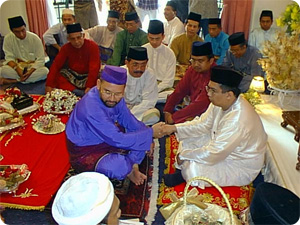
Nikaah is the wedding ceremony that can take place at some convenient venue or else at the bride or groom�s residence. The ceremony is conducted by the Maulvi (priest). Close friends and relatives witness the happening of the event. The father of the bride and groom, addressed as Walis, have an important role to play in the performance of nikaah. The priest reads certain verses from the Quran. Thereafter, Ijab-e-Qubul (proposal and acceptance) takes place.

The groom's side sends the proposal and the bride�s side gives her consent. For the legality of marriage, mutual consent is of prime importance. On the wedding day, the elderly members of both the families decide the amount of Mehar (nuptial gift). Mehar is a mandatory price that the groom�s family must pay to the bride.

Nikaahnama 
Nikaahnama is a legal document that must be duly signed by the bride, bridegroom, Maulvi and Walis for the marriage to be legal. It contains a set of terms and conditions that must be abided by both the parties.

Blessing The Groom 
The bridegroom seeks the blessings from the older women. As a mark of respect, the groom offers them �salaam�. People give their heartiest wishes to the newly wed.

Dinner, Prayers and Aarsimashaf 
The guests are served a lavish dinner. Men and women are usually seated separately, for dining. After the dinner, the newly wed get the chance to sit together for the first time. The heads of the bride and groom are covered using dupatta. Thereafter, the newly wed read prayers, as per the instructions of the Maulvi. The Quran is placed between the bride and groom and they are allowed to look at each other only through mirrors.

MUSLIM PRE-WEDDING RITUALS


Known as 'Nikah' in Urdu, the Muslim marriage is the most important ceremony for the Islam. It is a much awaited occasion, wherein the union of two souls is celebrated in an elegant and charming way. 

It is not just restricted to a single day. The formal procedures are divided into pre-wedding, wedding and post wedding, each being different from the other. The pre-wedding rituals make a Muslim wedding a very fascinating event to watch. The pre-wedding rituals of the Islam marriage are broadly divided into four phases. Check out information on the pre-wedding Muslimrituals in the following lines.

Muslim Pre-Wedding Customs

Istikhara, Imam-Zamin and Magni

The first phase of the pre-wedding Muslim rituals is known as Istikhara, wherein the religious head takes the approval of the Almighty to perform the wedding. After the consent, the groom's mother pays a visit to the bride's house along with sweets and Imam-Zamin, a silver or goin coin wrapped in silken cloth. 

The custom of tying the coin onto the upper portion of the bride's hand is called the Imam-Zamin ceremony. This is followed by Magni, which is a custom wherein the groom's family members pay a visit to the bride's house both the groom and the bride's family exchange sweets and fruits.

Manjha And Mehndi

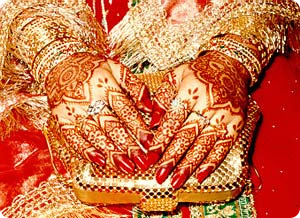
At the Manjha ceremony, the bride wears yellow clothes and turmeric paste is applied all over her body. After the application of turmeric, the bride is not supposed to step out of the house. This is followed by Mehndi ceremony, which is one of the much awaited rituals of the Muslim wedding.Female relatives of the bride apply turmeric paste all over her body. The purpose is to make the bride's skin glow naturally. A professional or a relative applies Mehndi on the bride�s hands and feet.

Archive