Showing posts with label JEWISH WEDDING CEREMONY. Show all posts

JEWISH POST WEDDING RITUAL


Partying and celebrating forms an important part in all weddings, and Jewish wedding is no exception. After following the rituals and ceremonies, it is time to let loose the hair and sway to the beats of music. Commonly, a Jewish wedding is followed by celebration and grand party. Once the religious practices are over, guests rejoice and make merry at the union of two individuals. In Judaism, it is a religious obligation for the guests to make new bride 
and groom happy on their wedding day. 


As per the conventional norms, these dinners are held for seven nights after the wedding, after which blessings for the bride and groom were recited by someone, who was not at the wedding. In orthodox families, men and women dance separately. To know more about the post wedding Jewish customs, check out the following lines.

Jewish Post Wedding Customs

Yichud
Amidst all the hustle bustle of marriage traditions and rituals, the bride and the groom, right after their wedding ceremony are given 15 minutes of seclusion time. During this time, the newly weds retreat to a private room. Generally, after a long day of fasting, it is the time when the bride and the groom feed each other a bite or two of their first meal together.

Seudat Mitzwah Jewish Wedding Feast
An important post wedding Jewish ritual is the reception party, in which mouthwatering Seudat Mitzwah Jewish wedding feast is served. At the time of reception, the newly wedded couple is made to sit in the center of the dancing circle. All friends and relatives get together and share joyous moments. After the week following the wedding, it is customary for friends and relatives to host festive meals in honor of the chatan (groom) and kallah (bride).

Mitzvah Dance
In certain Hasidic communities, it is customary for the bride to dance with the male members of the family. During the mitzvah tanz, the bride holds the groom's hand and her father's hand. However, while dancing with other men, she holds on to one end of a scarf or a gartel (belt), while the guest holds on to the other end.

JEWISH WEDDING RITUALS


For Jewish people, marriage is a fusion of two souls. They belief that God created the first man and woman (Adam and Eve) from one body and with the practice of marriage, they return to same oneness. A traditional Jewish wedding consists of significant rituals and beliefs. The wedding, not only indicates the beauty of the relationship of a couple, but also indicates their obligations to each other and to the Jewish society, as a whole. According to Rabbinic tradition, a marriage will be considered peaceful only if God is a part of the union. Jewish people have wedding rituals that are unique to their religion. Mostly Jewish wedding has two important phase - the kiddushin (engagement) and nissu'in (actual wedding). To get information about the beauty and joy of the Jewish wedding ceremonies, read through the following lines.

Jewish Wedding Customs

Wedding Ceremony
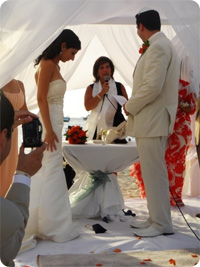
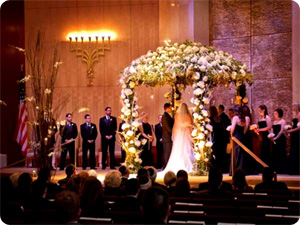
To begin with, the Rabbi checks the huppah, which is basically a canopy under which the religious ceremonies are carried out. This is done so as to ensure that there are two Kiddush cups and wine, which will be used during the performance of ceremony. The bridesmaids, usherers, maid and matron of honor, best man and other close relatives are made to stand around the huppah.

The groom and bride walk down the passage separately. Usually, they are accompanied by their parents. The bridegroom's side is the first to enter and the bride and her parents are the last ones. Thereafter, the couple is made to stand, next to each other, under the huppah. The huppah represents the new home of the couple. Over a cup of wine, the rabbi recites the blessings and the bride and groom are asked to take a sip. After that the couple exchanges their rings.

Reading Of Ketubah
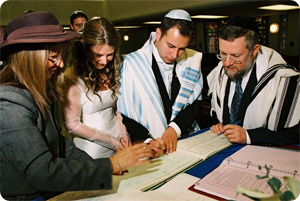
It is followed by the reading of Ketubah, the marriage contract that is written beforehand and duly signed by two witnesses. It also makes a clear mention of the dowry and the alimony amount that the wife will receive in case of divorce. The Rabbi hands over Ketubah to the bridegroom, which he further gives to his wife to keep. This completes the legal formalities of the marriage ceremony.

Sheva Berakhot Ceremony
In Sheva Berakhot ceremony, seven blessings are recited over a cup of wine, either by one Rabbi. Thereafter, the relatives come closer and bless the newly weds over a cup of wine. The blessings usually begin with thanking God for His creation and then proceeds further.

Breaking of the Glass
One of the most symbolic customs, in this, it is customary that an empty glass, covered with cloth, is kept under the bridegroom's feet and he is asked to break it. Through this act, the destruction of the temple in Jerusalem is recalled. Sometimes, both the bride and the groom can together break the glass. Thereafter, the bridegroom kisses his beloved wife. The breaking of the glass is also the official signal to shout, "Mazel Tov!" and start partying.

JEWISH PRE WEDDING RITUALS


Wedding, in Judaism, is considered as union of two souls for oneness and is hence, marked by great fervor and enthusiasm. The commencement of wedding celebration does not only mean the practice of wedding rituals, but making merry in the pre-ceremonial events as well. In almost all religions, wedding rituals begin days before the actual wedding day or D-Day and Jewish wedding is no exception to this fact. Friends and family gather together to toast, sing, dance and rejoice the upcoming celebration. 

There are two prominent rituals that take place, before the commencement of a Jewish wedding - Yom Kippur Viddui Confessional Prayers and Badeken tradition. In case you want to know in details about each of two pre-wedding ritual practiced, browse through the following lines.

Jewish Pre Wedding Customs


Sabbath
A week prior to the wedding day, the Choson (groom) and the Kallah (bride) do not see each other. Later, in that week, the Choson is called to the Torah (ufruf), to impress upon the couple the duty to look to the Torah as their guide in married life. Once the groom pronounces his promises, he is blessed with raisins and nuts. These are symbolic of their wishes for a sweet and fruitful marriage blessed with many children.

Yom Kippur Viddui Confessional Prayers
On the day of marriage, the groom and bride observe fast. If the wedding takes place in the afternoon time, the couple privately recites Yom Kippur Viddui confessional prayers. It is done before the wedding ceremony to forget the past and make a fresh beginning of married life.

Badeken Tradition
In this tradition, the bride and groom are given an opportunity to catch a glimpse of each other, along with the friends and relatives of either party. It takes place before the commencement of wedding ceremony. The bride is seated on the bed and is surrounded by her mother and relatives. The groom, then, lowers the veil of the veil over her face, setting her apart from everyone else and also stating that he is solely interested in her inner beauty.

Chuppah
The next stage is the chuppah, wherein a decorated piece of cloth held aloft as a symbolic home for the new couple. It is held outside underneath the starry sky. The groom, along with his parents, moves to the chuppah. While the groom offers prays for his unmarried friends so that they find their true partners in life, the bride enters the chuppah along with her parents.

Archive